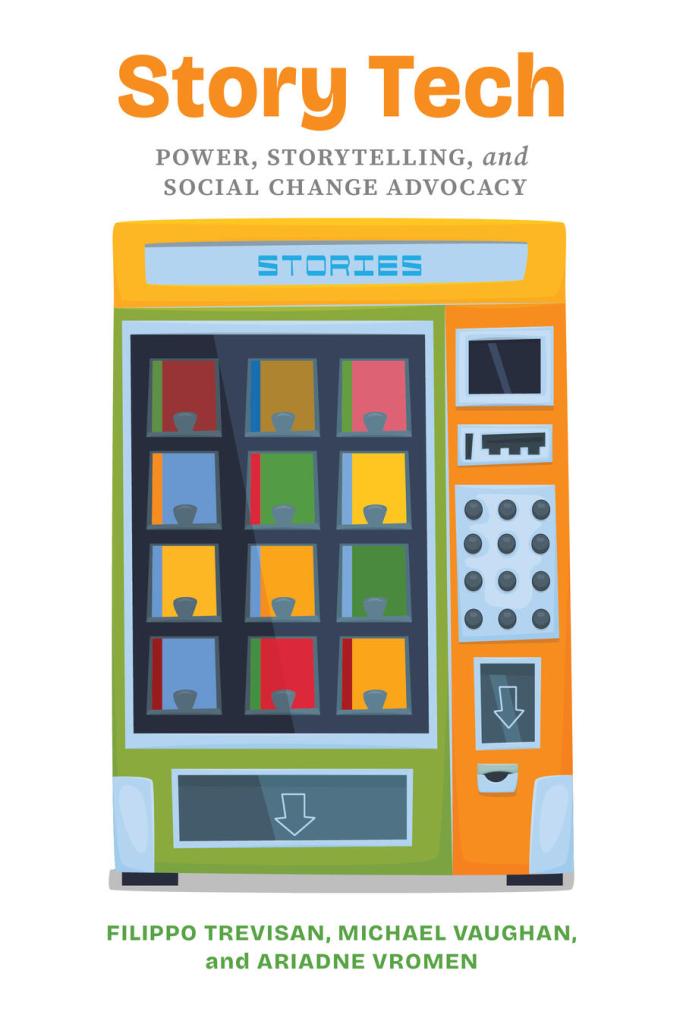
My new book Story Tech: Power, Storytelling, and Social Change Advocacy, co-authored with Michael Vaughan and Ariadne Vromen, was released in February 2025. To get 30% off, you can use code “UMS25” on the University of Michigan Press website, or check out the Open Access e-book version!
Book synopsis: Personal stories have the power to stir the heart, compel us to act, and spark social change. While advocacy organizations have long used storytelling in campaigns, the role technology plays has increased. Today, invitations to “share your story” are widespread on advocacy organizations and political campaigns’ websites, calls to action, and social media pages. But what happens after one clicks “share”? And how does this affect which voices we hear—and which we don’t—in public discourse?
Story Tech explores the increasingly influential impact of technologies—such as databases, algorithms, and digital story banks—that are usually invisible to the public. It shows that hidden “story tech” enables political organizations to treat stories as data that can be queried for storylines and used to intervene in news and information cycles in real time. In particular, the authors review successful story-centered campaigns that helped change dominant narratives on disability rights, marriage equality, and essential workers’ rights in the United States and Australia. They compare the use of storytelling advocacy across different types of organizations including volunteer grassroots groups, large national advocacy coalitions, and trade unions, and examine how trends differ for storytellers, organizers, and their technology partners. As political stories shift to being “on demand,” they reshape power relationships in key public debates in ways that produce moments of tension as well as positive narrative change. Story Tech examines the shift toward political story “on demand” and illustrates how storytelling success can—and should—be achieved in conjunction with personal dignity, privacy, and empowerment for storytellers and their communities, particularly marginalized ones.
 I’m delighted to share my latest open access article
 My latest article “Using the Internet to Mobilize Marginalized Groups: People with Disabilities and Digital Campaign Strategies in the 2016 U.S. Presidential Election” was recently published in the International Journal of Communication. This article discusses how the 2016 campaigns – particularly Hillary Clinton’s – tried to engage with the disability community online and draws key lessons about the inclusion of people with disabilities and other minority groups in digital election strategy planning. The full paper can be accessed freely
  My latest article is just out in the Australian Journal of Political Science. “
 Filippo Trevisan