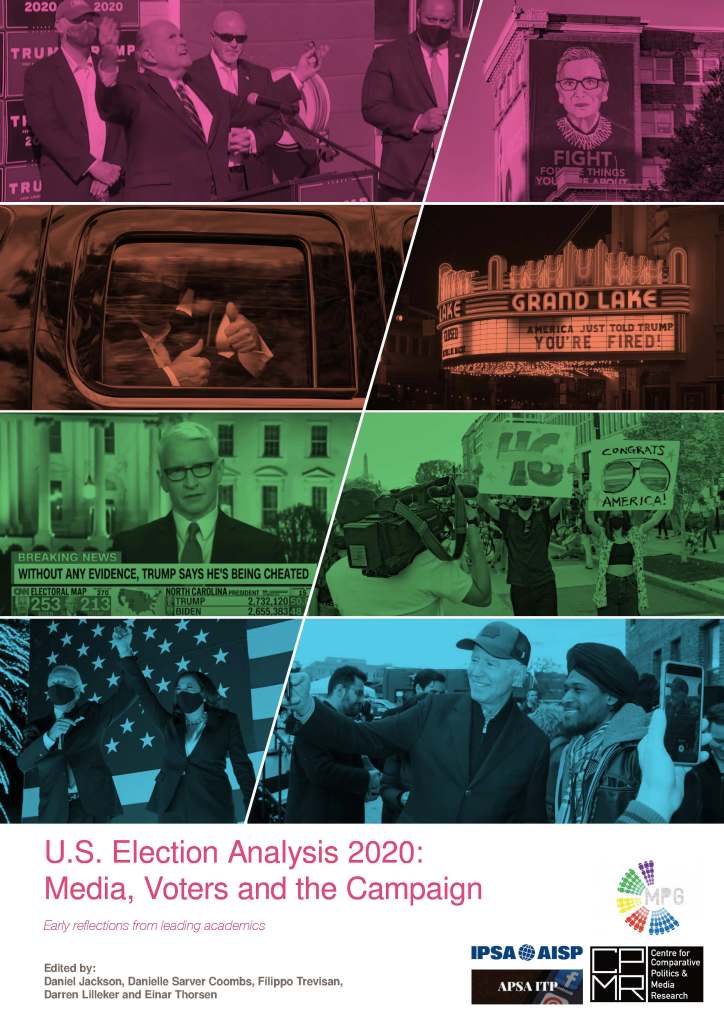
91 short and accessible articles from 115 leading media and politics researchers from around the world: I’m very proud to have co-edited the U.S. Election Analysis 2020: Voters, Media, and the Campaign together with a stellar team of colleagues from Bournemouth University (Dan Jackson, Darren Lilleker, and Einar Thorsen) and Kent State University (Danielle Coombs).
Published less than two weeks after the November 3, 2020 election, this volume includes immediate reaction and analysis pieces – including research findings and new theoretical insights – that help readers understand the campaign and its significance for the future of American democracy. U.S. Election Analysis 2020: Voters, Media, and the Campaign is a valuable resource for researchers, educators, journalists, and policy-makers that is freely accessible and organized around seven main topics, including:
- Policy & political context
- Voters
- Candidates & the campaign
- News & journalism
- Social Media
- Popular culture & public critique
- Democracy in crisis
You can find our introduction with a brief overview of the contents of each section here.
We’re grateful to the Center for Comparative Politics and Media Research at Bournemouth University, the APSA Information Technology and Politics Section, the Political Studies Association’s Media and Politics Group, and the IPSA Political Communication Research Committee for their support.
 As the October 7 Brazilian elections draw closer, I talked to Folha de São Paulo – Brazil’s most-read newspaper – about Google Trends and what it can tell us about key election information trends. Although Google Trends data can’t predict election outcomes, they show a marked rise in interest for populist firebrand and presidential hopeful Jair Bolsonaro. Read the full article
  I am thrilled to share the publication of a new single-authored article in the journal Public Relations Inquiry. The article, titled “Crowd-Sourced Advocacy: Promoting Disability Rights Through Online Storytelling,” examines the emergent promotional tactic of creating protest counter-narratives by aggregating personal stories collected from supporters of online disability rights networks. The content, potential efficacy, and implications for those involved are reviewed. This article is part of a special issue on promotional cultures and PR that includes research presented at the “Powers of Promotion” 2016 ICA Pre-conference in Tokyo. To access the full article, click
  Filippo Trevisan