New Book! Story Tech: Power, Storytelling and Social Change Advocacy

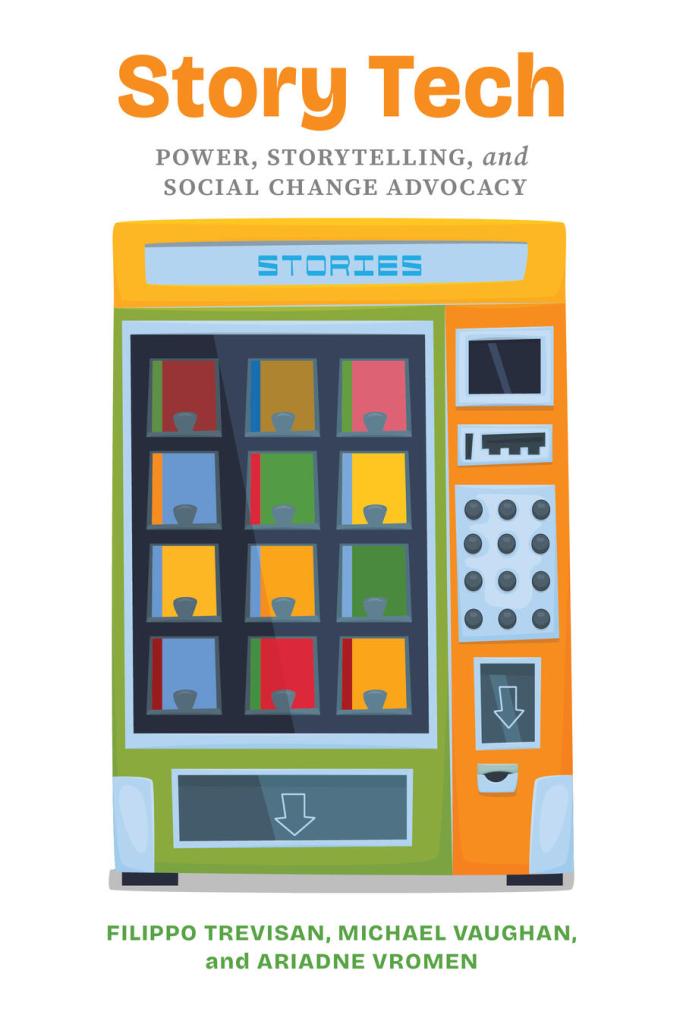
My new book Story Tech: Power, Storytelling, and Social Change Advocacy, co-authored with Michael Vaughan and Ariadne Vromen, was released in February 2025. To get 30% off, you can use code “UMS25” on the University of Michigan Press website, or check out the Open Access e-book version!

Book synopsis: Personal stories have the power to stir the heart, compel us to act, and spark social change. While advocacy organizations have long used storytelling in campaigns, the role technology plays has increased. Today, invitations to “share your story” are widespread on advocacy organizations and political campaigns’ websites, calls to action, and social media pages. But what happens after one clicks “share”? And how does this affect which voices we hear—and which we don’t—in public discourse?
 
Story Tech explores the increasingly influential impact of technologies—such as databases, algorithms, and digital story banks—that are usually invisible to the public. It shows that hidden “story tech” enables political organizations to treat stories as data that can be queried for storylines and used to intervene in news and information cycles in real time. In particular, the authors review successful story-centered campaigns that helped change dominant narratives on disability rights, marriage equality, and essential workers’ rights in the United States and Australia. They compare the use of storytelling advocacy across different types of organizations including volunteer grassroots groups, large national advocacy coalitions, and trade unions, and examine how trends differ for storytellers, organizers, and their technology partners. As political stories shift to being “on demand,” they reshape power relationships in key public debates in ways that produce moments of tension as well as positive narrative change. Story Tech examines the shift toward political story “on demand” and illustrates how storytelling success can—and should—be achieved in conjunction with personal dignity, privacy, and empowerment for storytellers and their communities, particularly marginalized ones.
Routledge Handbook of Political Campaigning, published November 2024

In politics, timing matters. So, I’m thrilled to announce the release of the Routledge Handbook of Political Campaigning this November, in time for the U.S. 2024 elections! This volume, which I edited together with a stellar team including Darren Lilleker, Dan Jackson, Anastasia Veneti (Bournemouth University, England), Bente Kalsnes (Kristiania University College, Norway), and Claudia Mellado (Pontificia Universidad Católica de Valparaíso, Chile), offers an in-depth review of key trends in political communication and campaigning from various angles, from campaign tactics to civil society interventions, through 34 chapters that focus on case studies and countries well beyond the ‘usual suspects’ (U.S., UK). You can read more about the book and freely access a preview that includes the introductory chapter here.

#Notplayinggames: Social media advocacy at the Paris Paralympics

Did you notice the Paralympics on TikTok this year? You weren’t the only one! I enjoyed writing a short piece on the International Paralympic Committee’s bold and effective (though somewhat controversial) social media strategy, which made a big splash, got people talking about disability, and created a permission structure for athletes to engage in media advocacy. You can read more about this in this fabulous (and free!) report on the Paris Olympics, Paralympics, Media, and the Politics of Sports with contributions from over 100 leading experts.

New Article on Instagram Influencers with Disabilities in Celebrity Studies

Manuela Farinosi (University of Udine, Italy) and I have a new article out in Celebrity Studies: “Disabled influencers on Instagram: exploring digital celebrity and marginalised identities” (part of a special issue on Social Media Influencers edited by Rebecca Feasey). Here below is the abstract and you can access the full-text article at this link (if you can’t access it through your library and need a free copy, please just reach out and I’ll be glad to share one with you).

This article illuminates the nexus of social media, celebrity, and marginalised identities by examining the phenomenon of disabled influencers. Since the late 2010s, disability representations in media, culture, and public discourse have increasingly moved away from stigmatising stereotypes. Disabled influencers have emerged as new voices in this landscape but, so far, exploration of their work has been limited. To address this gap, this study explores how 15 diverse fashion influencers with visible impairments address disability in their personal brands, whether they frame themselves as advocates for disability rights, and investigates their relationships with both followers and commercial brands. Through a content analysis of one year worth of Instagram posts (N = 1,429) and profile information, we outline the strategies these influencers use to make disability central to their online personas, explore their multi-layered relationship with brands, identify their distinct but somewhat limited voice in disability advocacy, and highlight their engagement strategies with digital publics. Drawing on disability and celebrity scholarship, this work provides insights on how the use of participatory platforms like Instagram intersects with the changing demands and expectations of celebrity, generating both opportunities and constraints for traditionally marginalised groups. 

Exploring digital inclusivity in U.S. progressive politics – new article in New Media & Society

My latest article titled Beyond accessibility: Exploring digital inclusivity in U.S. progressive digital politics was published recently in the journal New Media & Society. This work, which is part of a journal special issue on Vulnerability and Digital Media, draws on the experience of digital organizers with disabilities in the 2020 U.S. election campaigns to sketch a new framework to understand and study inclusivity in online politics as a “process.” This breaks with the restrictive interpretation of inclusion as an “outcome” of digital political participation and is intended to open new avenues for elevating under-represented voices in political communication research and practice.

The 2020 U.S. election was a watershed moment for inclusivity in digital politics due to activist pressure, cultural change, and the pandemic. The article highlights key role of disabled advocates and digital organizers – both from inside campaign organizations and from outside through initiatives like #cripthevote – in making candidates and their organizations more responsive. With digital campaigning center stage during the pandemic, crisis again proved to be an innovation catalyst in digital politics. Now, the sustainability of digital inclusivity depends on whether cultural change that views disabled people as full citizens and a key group to mobilize takes root in political organizations for the long term.

Here below is a copy of the abstract, you can find the full paper here (please get in touch directly if you’d like a pre-print version):

This article explores inclusivity in the context of digital politics. As online campaigns and digital participation become increasingly central to democratic politics, it is essential to better understand the implications of this shift for marginalized and politically vulnerable people. Focusing on people with disabilities, this study applies a grounded theory approach to investigate what factors shape inclusivity in digital politics and begins to theorize this under-researched concept. Through interviews with self-advocates and election professionals with disabilities involved in innovative digital mobilization efforts for progressive US political organizations and campaigns, as well as a review of related strategies, this article illuminates digital inclusivity as a “process” connected to, but also distinct from the “outcomes” of social and political inclusion and exclusion. Key incentives and obstacles are identified, and emerging principles of digital inclusivity that are simultaneously community-rooted and sensitive to the context of contemporary US politics are discussed.

Open Science, Closed Doors? New article in JOC (with free pre-print)

I have a new article out in the Journal of Communication with an amazing team of co-authors: “Open Science, Closed Doors? Countering Marginalization through an Agenda for Ethical, Inclusive Research in Communication” (see below for free pre-print).

This piece reflects on current trends that emphasize open science practices and values in communication research, and discusses the need to better understand and counter their implications for research with marginalized populations and by marginalized researchers. The seed for this work was planted at an ICA 2020 roundtable organized by Katy Pearce and Jesse Fox, and expanded collaboratively by a diverse team of authors including: Adrienne Massanari, Julius Matthew Riles, Lukasz Szulc, Yerina Ranjit, Cheryll Soriano, Filippo Trevisan, Jessica Vitak, Payal Arora, Sun Joo (Grace) Ahn, Meryl Alper, Andrew Gambino, Carmen Gonzalez, Teresa Lynch, Lillie Williamson, and Amy Gonzales.

Here’s the abstract — a pre-print full text version is also available for download below:

The open science (OS) movement has advocated for increased transparency in certain aspects of research. Communication is taking its first steps toward OS as some journals have adopted OS guidelines codified by another discipline. We find this pursuit troubling as OS prioritizes openness while insufficiently addressing essential ethical principles: respect for persons, beneficence, and justice. Some recommended open science practices increase the potential for harm for marginalized participants, communities, and researchers. We elaborate how OS can serve a marginalizing force within academia and the research community, as it overlooks the needs of marginalized scholars and excludes some forms of scholarship. We challenge the current instantiation of OS and propose a divergent agenda for the future of Communication research centered on ethical, inclusive research practices.

New Trends in Citizen Media: Disability Media

Citizen media have flourished and taken on new forms on the internet, and people with disabilities have been among the pioneers in this area as they sought to increase their agency in how disability is represented and aimed to create media that are not only accessible, but also relevant to people with a wide range of disabilities. I explored the evolution of “Disability Media” — media created by people with disabilities with a view to presenting distinctive disability viewpoints on key issues and experiences relevant to the disability community — and their relationship with ever changing technologies in an entry in the recently published Routledge Encyclopedia of Citizen Media.

There is an incredible amount of grassroots innovation in today’s disability media, and this new entry seeks to capture and critically discuss the work of these citizen media activists in conjunction with long term trends in media representations and technological evolution. Here’s a short summary of the entry (contact me for a pre-print copy of the full text):

Disability and disability-related issues are often ignored or misrepresented in mainstream news and popular media. Disability scholars have also argued that initiatives launched by major news organizations to provide better representations of disability, such as the BBC’s Ouch! website, have fallen short of expectations to incorporate the perspective of persons with disabilities effectively (Riley 2005). In addition, traditional forms of media are not fully accessible to Deaf and hard-of-hearing people, nor to people with different disabilities including, to name a few, blind and vision-impaired people, people with intellectual disabilities, and language processing issues. To address these problems, disability communities and Disabled People’s Organizations (DPOs) have built alternative media outlets with a view to providing accessible news coverage, enhancing the visibility of disability issues, and contrasting ableist and stereotypical representations of disability both within news and popular culture (Ellis and Goggin 2015a; Haller, 2010). While historically most of these efforts were oriented toward the provision of information to the disability community and meeting its various accessibility needs, the proliferation of digital media has enabled exponential growth in the disability media sector. Dozens of new disability news websites, blogs, podcasts, sign language video services on YouTube and other media are created every year, and can reach ever expanding audiences (Ellis and Goggin 2015b). Importantly, many of these outlets seek to have an impact beyond the disability community and influence legacy media and non-disabled audiences more broadly.

This entry provides a brief history of disability media initiatives and reviews their relationship with the changing technologies and organizational structures that support them. In particular, grassroots projects that seek to empower aspiring disabled writers, reporters, and videographers and augment the visibility of their content, such as Rooted in Rights and The Disability Visibility Project, are presented. The entry discusses how these initiatives, which follow in the footsteps of community-based projects that equipped people with disabilities with key journalistic skills (Thorsen, Jackson and Luce 2015) and build on the use of unmediated storytelling in disability rights advocacy (Trevisan, 2017), empower new disabled voices to challenge the status quo, enrich news and popular culture with more diverse disability representations, and can become catalysts for the participation of the disability community in key civic moments such as elections and important policy debates.

Doing Inclusive Research: Tips for Accessible Focus Groups

Doing Inclusive Research: Tips for Accessible Focus Groups

I love running focus groups, both from a research and human perspective, but traditionally this method has been far from universally accessible. For example, traditional focus groups present important challenges for people with communication disabilities and disorders, which currently are over 10% of the U.S. adult population.

As someone who cares deeply about the inclusion of traditionally under-represented voices in research, I think there’s a lot that we can do to re-think methodologies to make them more accessible. In an article I published in the journal Qualitative Research earlier this year, I drew on my experience organizing, moderating, and analyzing focus groups to discuss low-cost, relatively straightforward, and flexible solutions to ensure that people with communication disabilities and disorders are equally as empowered as any other participant to contribute their perspectives, opinions, and experiences to these studies. While this article can only begin to scratch the surface of this issue, I hope it will help us start a conversation about how to adapt and innovate qualitative research in all fields to make it simultaneously more inclusive and more valid.

You can find the full article here (get in touch directly for a pre-print version, if you like):

Trevisan, F. (2020) Making focus groups accessible and inclusive for people with communication disabilities: a research note. Qualitative Research, published online before print.

And here’s the abstract for a quick preview:

Participating in focus groups can be challenging for people with communication disabilities. Given that more than 1 in 10 adults has a communication disability, focus groups that overlook their needs exclude a large part of the population. This research note makes a unique contribution toward creating more inclusive focus groups by discussing a variety of strategies employed in a recent study of political participation among Americans with disabilities that included a high proportion of participants with communication disorders. Universal design principles can support the “mainstreaming” of communication disabilities in focus group research, contributing to more inclusive and representative social science scholarship.

“Sport Communication and Social Justice” Special Issue Published

C&S CoverThe double special issue of Communication & Sport I co-edited with Dan Jackson (Bournemouth University), Emma Pullen (Loughborough University), and Mike Silk (Bournemouth University) is out! We’re very proud to include thirteen top-notch articles that discuss the nexus of communication, sport, and social justice as it relates to race, gender, disability and more in this double special issue. In the introductory article, we sketch out an ambitious agenda for this nascent field of inquiry and hope this will help foster innovative intellectual pursuits at the crossroads of scholarship, practice, and activism.
Check out the special issue here. Read our introductory article here.

New Article on ‘Story Banks’ in Grassroots Advocacy

4.HERO-size-2-1024x252“Mobilizing Personal Narratives: The Rise of Digital ‘Story Banking’ in U.S. Grassroots Advocacy” is a brand new article by myself, Bryan Bello (American University), Michael Vaughan (Weizenbaum Institute) and Ariadne Vromen (University of Sydney) that was recently published in the Journal of Information Technology and Politics. In this piece, which is part of a larger project on the recent evolution of digital storytelling in grassroots advocacy in both the U.S. and Australia, we offer the first definition and critical evaluation of digital story banking techniques that are increasingly popular with advocacy groups in the U.S. For a brief summary and little teaser on the full article, check out this post on the AU Center for Media and Social Impact’s blog.

Here is a copy of the abstract; for a full copy of the article click here or, if you need an open access pre-print copy, please get in touch directly:

This article interrogates digital “story banking,” a storytelling practice that has become increasingly popular among U.S. grassroots advocacy organizations. Through the examination of LinkedIn data and in-depth interviews with story banking professionals, this technique emerges as the centerpiece of the growing institutionalization, professionalization, and datafication of storytelling in progressive advocacy. Following the 2016 election, political crisis and an increasing awareness of changing information consumption patterns promoted story banking diffusion. Story banking ushers in the era of stories as data and political story on demand. Yet, political constraints currently limit story banking to a reactive approach based on news monitoring, algorithmic shortlisting of stories, and audience testing. Furthermore, an unresolved tension has emerged between the growing centralization of storytelling functions and the participatory potential of crowd-sourced story banks. The implications of these trends for progressive advocacy organizations and the groups they aim to represent are considered.