New Book! Story Tech: Power, Storytelling and Social Change Advocacy

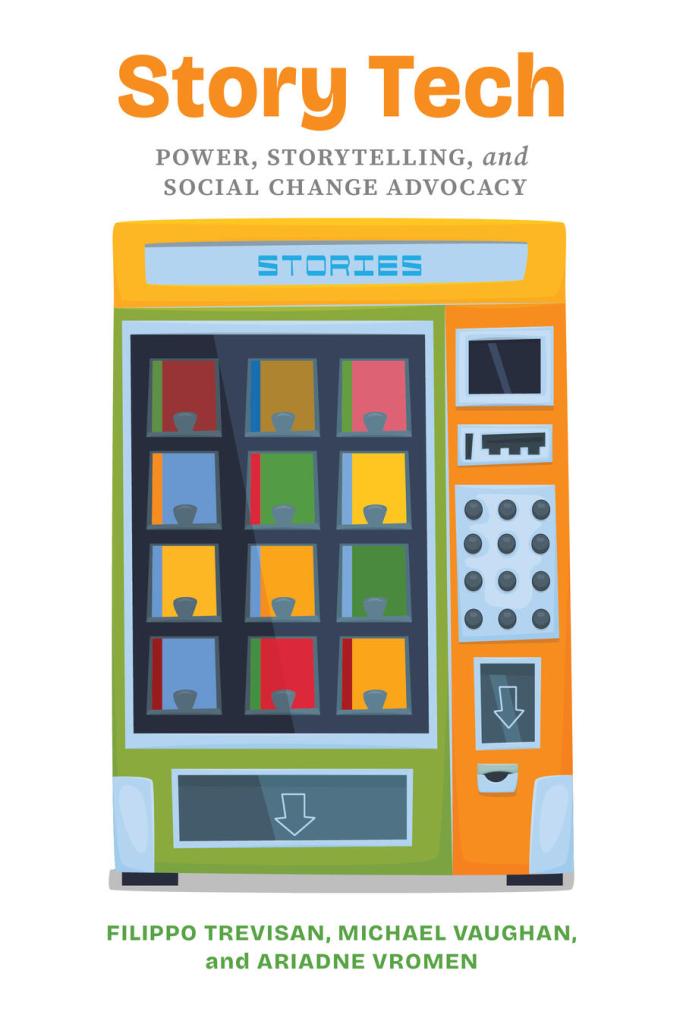
My new book Story Tech: Power, Storytelling, and Social Change Advocacy, co-authored with Michael Vaughan and Ariadne Vromen, was released in February 2025. To get 30% off, you can use code “UMS25” on the University of Michigan Press website, or check out the Open Access e-book version!

Book synopsis: Personal stories have the power to stir the heart, compel us to act, and spark social change. While advocacy organizations have long used storytelling in campaigns, the role technology plays has increased. Today, invitations to “share your story” are widespread on advocacy organizations and political campaigns’ websites, calls to action, and social media pages. But what happens after one clicks “share”? And how does this affect which voices we hear—and which we don’t—in public discourse?
 
Story Tech explores the increasingly influential impact of technologies—such as databases, algorithms, and digital story banks—that are usually invisible to the public. It shows that hidden “story tech” enables political organizations to treat stories as data that can be queried for storylines and used to intervene in news and information cycles in real time. In particular, the authors review successful story-centered campaigns that helped change dominant narratives on disability rights, marriage equality, and essential workers’ rights in the United States and Australia. They compare the use of storytelling advocacy across different types of organizations including volunteer grassroots groups, large national advocacy coalitions, and trade unions, and examine how trends differ for storytellers, organizers, and their technology partners. As political stories shift to being “on demand,” they reshape power relationships in key public debates in ways that produce moments of tension as well as positive narrative change. Story Tech examines the shift toward political story “on demand” and illustrates how storytelling success can—and should—be achieved in conjunction with personal dignity, privacy, and empowerment for storytellers and their communities, particularly marginalized ones.

Routledge Handbook of Political Campaigning, published November 2024

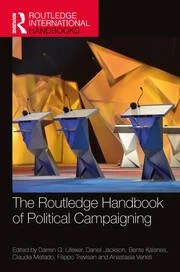
In politics, timing matters. So, I’m thrilled to announce the release of the Routledge Handbook of Political Campaigning this November, in time for the U.S. 2024 elections! This volume, which I edited together with a stellar team including Darren Lilleker, Dan Jackson, Anastasia Veneti (Bournemouth University, England), Bente Kalsnes (Kristiania University College, Norway), and Claudia Mellado (Pontificia Universidad Católica de Valparaíso, Chile), offers an in-depth review of key trends in political communication and campaigning from various angles, from campaign tactics to civil society interventions, through 34 chapters that focus on case studies and countries well beyond the ‘usual suspects’ (U.S., UK). You can read more about the book and freely access a preview that includes the introductory chapter here.

New Article on Instagram Influencers with Disabilities in Celebrity Studies

Manuela Farinosi (University of Udine, Italy) and I have a new article out in Celebrity Studies: “Disabled influencers on Instagram: exploring digital celebrity and marginalised identities” (part of a special issue on Social Media Influencers edited by Rebecca Feasey). Here below is the abstract and you can access the full-text article at this link (if you can’t access it through your library and need a free copy, please just reach out and I’ll be glad to share one with you).

This article illuminates the nexus of social media, celebrity, and marginalised identities by examining the phenomenon of disabled influencers. Since the late 2010s, disability representations in media, culture, and public discourse have increasingly moved away from stigmatising stereotypes. Disabled influencers have emerged as new voices in this landscape but, so far, exploration of their work has been limited. To address this gap, this study explores how 15 diverse fashion influencers with visible impairments address disability in their personal brands, whether they frame themselves as advocates for disability rights, and investigates their relationships with both followers and commercial brands. Through a content analysis of one year worth of Instagram posts (N = 1,429) and profile information, we outline the strategies these influencers use to make disability central to their online personas, explore their multi-layered relationship with brands, identify their distinct but somewhat limited voice in disability advocacy, and highlight their engagement strategies with digital publics. Drawing on disability and celebrity scholarship, this work provides insights on how the use of participatory platforms like Instagram intersects with the changing demands and expectations of celebrity, generating both opportunities and constraints for traditionally marginalised groups. 

Exploring digital inclusivity in U.S. progressive politics – new article in New Media & Society

My latest article titled Beyond accessibility: Exploring digital inclusivity in U.S. progressive digital politics was published recently in the journal New Media & Society. This work, which is part of a journal special issue on Vulnerability and Digital Media, draws on the experience of digital organizers with disabilities in the 2020 U.S. election campaigns to sketch a new framework to understand and study inclusivity in online politics as a “process.” This breaks with the restrictive interpretation of inclusion as an “outcome” of digital political participation and is intended to open new avenues for elevating under-represented voices in political communication research and practice.

The 2020 U.S. election was a watershed moment for inclusivity in digital politics due to activist pressure, cultural change, and the pandemic. The article highlights key role of disabled advocates and digital organizers – both from inside campaign organizations and from outside through initiatives like #cripthevote – in making candidates and their organizations more responsive. With digital campaigning center stage during the pandemic, crisis again proved to be an innovation catalyst in digital politics. Now, the sustainability of digital inclusivity depends on whether cultural change that views disabled people as full citizens and a key group to mobilize takes root in political organizations for the long term.

Here below is a copy of the abstract, you can find the full paper here (please get in touch directly if you’d like a pre-print version):

This article explores inclusivity in the context of digital politics. As online campaigns and digital participation become increasingly central to democratic politics, it is essential to better understand the implications of this shift for marginalized and politically vulnerable people. Focusing on people with disabilities, this study applies a grounded theory approach to investigate what factors shape inclusivity in digital politics and begins to theorize this under-researched concept. Through interviews with self-advocates and election professionals with disabilities involved in innovative digital mobilization efforts for progressive US political organizations and campaigns, as well as a review of related strategies, this article illuminates digital inclusivity as a “process” connected to, but also distinct from the “outcomes” of social and political inclusion and exclusion. Key incentives and obstacles are identified, and emerging principles of digital inclusivity that are simultaneously community-rooted and sensitive to the context of contemporary US politics are discussed.

“Sport Communication and Social Justice” Special Issue Published

C&S CoverThe double special issue of Communication & Sport I co-edited with Dan Jackson (Bournemouth University), Emma Pullen (Loughborough University), and Mike Silk (Bournemouth University) is out! We’re very proud to include thirteen top-notch articles that discuss the nexus of communication, sport, and social justice as it relates to race, gender, disability and more in this double special issue. In the introductory article, we sketch out an ambitious agenda for this nascent field of inquiry and hope this will help foster innovative intellectual pursuits at the crossroads of scholarship, practice, and activism.

Check out the special issue here. Read our introductory article here.

New Article on Social Media, Disability, and Mental Health in Elections

SM+S coverI’m delighted to share my latest open access article ‘Do you want to be a well-informed citizen, or do you want to be sane?’ Social Media, Disability, Mental Health and Political Marginality, which was published earlier this month in Social Media + Society. The article reviews evidence from focus groups with voters with disabilities to explore their experience with Facebook, YouTube, and Twitter during the 2016 U.S. Presidential election. From this, social media platforms emerge as both empowering tools and sources of mental health problems for this traditionally marginalized group in an increasingly polarized political context such as the U.S.
This article is part of a forthcoming special issue on Social Media and Marginality expertly edited by Katy Pearce, Amy Gonzales, and Brooke Focault-Welles.

Here is a copy of the abstract, for the full open access article click here.

This article examines the experiences of people with disabilities, a traditionally marginalized group in US politics, with social media platforms during the 2016 presidential election. Using focus groups with participants with a wide range of disabilities, the significance of YouTube, Twitter, and Facebook is discussed. Results highlight ambivalent experiences with these platforms, which support some elements of political inclusion (more accessible and more relevant election information) but at the same time also exacerbate aspects of marginality (stress, anxiety, isolation). Four coping strategies devised by participants to address digital stress (self-censorship, unfollowing/unfriending social media contacts, signing off, and taking medication) are illustrated. The relationship between these contrasting findings, social media design and affordances, as well as potential strategies to eliminate an emerging trade-off between discussing politics online and preserving mental health and social connectedness for people with disabilities are discussed.

New Article on ‘Story Banks’ in Grassroots Advocacy

4.HERO-size-2-1024x252“Mobilizing Personal Narratives: The Rise of Digital ‘Story Banking’ in U.S. Grassroots Advocacy” is a brand new article by myself, Bryan Bello (American University), Michael Vaughan (Weizenbaum Institute) and Ariadne Vromen (University of Sydney) that was recently published in the Journal of Information Technology and Politics. In this piece, which is part of a larger project on the recent evolution of digital storytelling in grassroots advocacy in both the U.S. and Australia, we offer the first definition and critical evaluation of digital story banking techniques that are increasingly popular with advocacy groups in the U.S. For a brief summary and little teaser on the full article, check out this post on the AU Center for Media and Social Impact’s blog.

Here is a copy of the abstract; for a full copy of the article click here or, if you need an open access pre-print copy, please get in touch directly:

This article interrogates digital “story banking,” a storytelling practice that has become increasingly popular among U.S. grassroots advocacy organizations. Through the examination of LinkedIn data and in-depth interviews with story banking professionals, this technique emerges as the centerpiece of the growing institutionalization, professionalization, and datafication of storytelling in progressive advocacy. Following the 2016 election, political crisis and an increasing awareness of changing information consumption patterns promoted story banking diffusion. Story banking ushers in the era of stories as data and political story on demand. Yet, political constraints currently limit story banking to a reactive approach based on news monitoring, algorithmic shortlisting of stories, and audience testing. Furthermore, an unresolved tension has emerged between the growing centralization of storytelling functions and the participatory potential of crowd-sourced story banks. The implications of these trends for progressive advocacy organizations and the groups they aim to represent are considered.


Culture, Diversity and Inclusion Mini-Track at HICSS 52

This week I’m honored to co-chair the Culture, Diversity and Inclusion mini-track at the 52nd Hawaii International Conference on System Sciences (HICSS) together with my AU colleagues Derrick Cogburn and Nanette Levinson. The mini-track includes two exciting sessions at 8:00am and 10:00am on Friday January 11th with a total of five papers focusing on issues of disability, race, and age in digital and social media.

As part of this mini-track, I’m also going to present a paper I co-authored with Derrick Cogburn on “Technology and Grassroots Inclusion in Global Governance: A Survey Study of Disability Rights Advocates and Effective Participation.” The paper discusses the first global survey of disability rights advocates about their use of technology to participate in global governance processes including both U.N. and non-U.N. international meetings, conferences, and events, as well as the use of social media to engage with disability grassroots in their respective countries. To access a free copy of the paper, click here.

“Disability Rights Advocacy Online” Reviewed in Disability & Society

My book “Disability Rights Advocacy Online: Voice, Empowerment and Global Connectivity” received a great review in Disability & Society, the premier scholarly journal in disability studies. In the review, Gabor Petri (University of Kent) wrote that “Disability Rights Advocacy Online is a book by Filippo Trevisan that has been badly missing from disability studies. […] traditional social movement studies usually ignore disability – but one could argue that disability studies equally bypasses social movement and media studies. This book is capable of not only filling a gap between these disciplines but also proposes questions and shows directions for further research. […] Trevisan’s excellent book will inspire researchers to build on the best traditions of disability studies and do more work in this multidisciplinary, fertile area for inquiries.

To read the full review, click here (free access).

To learn more and purchase the book, click here (use code “FLR40” at checkout for 20% off).

New White Paper: Accessibility in Global Governance

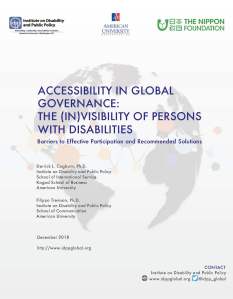
AGG cover pageOn International Day of Persons with Disabilities 2018, the Institute on Disability and Public Policy (IDPP) launched a new white paper report on “Accessibility in Global Governance: The (In)Visibility of Persons with Disabilities.” Co-authored by the IDPP Executive Director Derrick Cogburn and myself, this white paper is the culmination of a two-year research project that included subject matter expert interviews and a global survey of disability rights advocates from over 50 countries, most of whom in developing parts of the world.

This research, which was supported by The Nippon Foundation, is the first study to comprehensively map barriers to accessibility at United Nations meetings, conferences, and events, as well as other important international forums. In addition, the report also offers examples and recommendations based on recent international conferences that pioneered the use of accessible Information and Communication Technologies (ICTs, including both web-conferencing software and telepresence robots) to facilitate effective remote participation for people with disabilities.

To read and download the full report, click here.