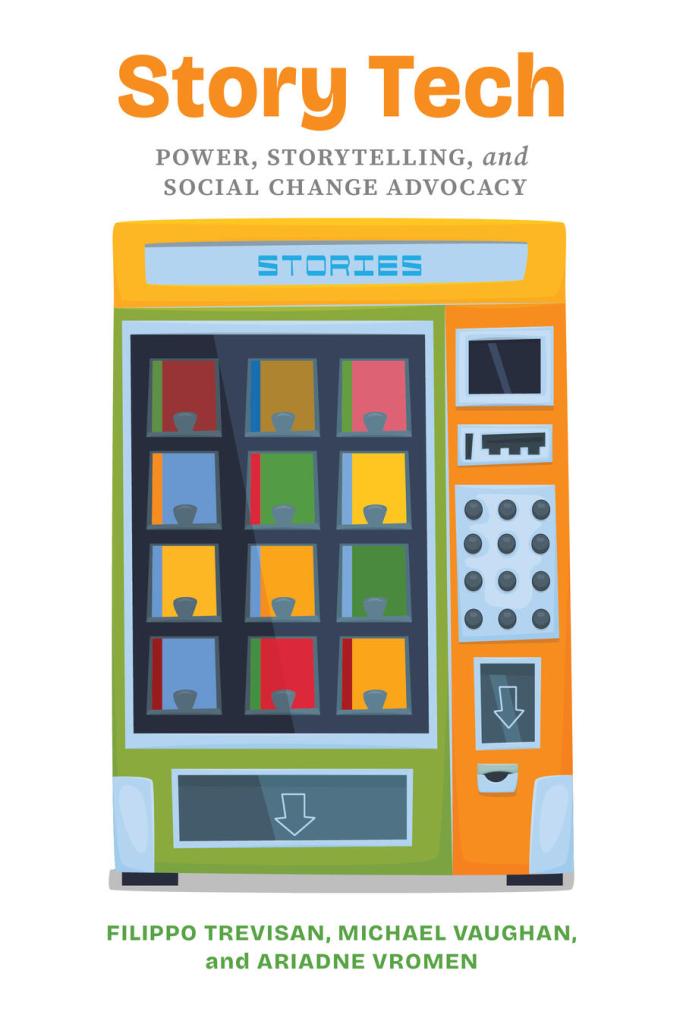
New Book! Story Tech: Power, Storytelling and Social Change Advocacy

My new book Story Tech: Power, Storytelling, and Social Change Advocacy, co-authored with Michael Vaughan and Ariadne Vromen, was released in February 2025. To get 30% off, you can use code “UMS25” on the University of Michigan Press website, or check out the Open Access e-book version!

Book synopsis: Personal stories have the power to stir the heart, compel us to act, and spark social change. While advocacy organizations have long used storytelling in campaigns, the role technology plays has increased. Today, invitations to “share your story” are widespread on advocacy organizations and political campaigns’ websites, calls to action, and social media pages. But what happens after one clicks “share”? And how does this affect which voices we hear—and which we don’t—in public discourse?
 
Story Tech explores the increasingly influential impact of technologies—such as databases, algorithms, and digital story banks—that are usually invisible to the public. It shows that hidden “story tech” enables political organizations to treat stories as data that can be queried for storylines and used to intervene in news and information cycles in real time. In particular, the authors review successful story-centered campaigns that helped change dominant narratives on disability rights, marriage equality, and essential workers’ rights in the United States and Australia. They compare the use of storytelling advocacy across different types of organizations including volunteer grassroots groups, large national advocacy coalitions, and trade unions, and examine how trends differ for storytellers, organizers, and their technology partners. As political stories shift to being “on demand,” they reshape power relationships in key public debates in ways that produce moments of tension as well as positive narrative change. Story Tech examines the shift toward political story “on demand” and illustrates how storytelling success can—and should—be achieved in conjunction with personal dignity, privacy, and empowerment for storytellers and their communities, particularly marginalized ones.
#Notplayinggames: Social media advocacy at the Paris Paralympics

Did you notice the Paralympics on TikTok this year? You weren’t the only one! I enjoyed writing a short piece on the International Paralympic Committee’s bold and effective (though somewhat controversial) social media strategy, which made a big splash, got people talking about disability, and created a permission structure for athletes to engage in media advocacy. You can read more about this in this fabulous (and free!) report on the Paris Olympics, Paralympics, Media, and the Politics of Sports with contributions from over 100 leading experts.

New Article on ‘Story Banks’ in Grassroots Advocacy

4.HERO-size-2-1024x252“Mobilizing Personal Narratives: The Rise of Digital ‘Story Banking’ in U.S. Grassroots Advocacy” is a brand new article by myself, Bryan Bello (American University), Michael Vaughan (Weizenbaum Institute) and Ariadne Vromen (University of Sydney) that was recently published in the Journal of Information Technology and Politics. In this piece, which is part of a larger project on the recent evolution of digital storytelling in grassroots advocacy in both the U.S. and Australia, we offer the first definition and critical evaluation of digital story banking techniques that are increasingly popular with advocacy groups in the U.S. For a brief summary and little teaser on the full article, check out this post on the AU Center for Media and Social Impact’s blog.

Here is a copy of the abstract; for a full copy of the article click here or, if you need an open access pre-print copy, please get in touch directly:

This article interrogates digital “story banking,” a storytelling practice that has become increasingly popular among U.S. grassroots advocacy organizations. Through the examination of LinkedIn data and in-depth interviews with story banking professionals, this technique emerges as the centerpiece of the growing institutionalization, professionalization, and datafication of storytelling in progressive advocacy. Following the 2016 election, political crisis and an increasing awareness of changing information consumption patterns promoted story banking diffusion. Story banking ushers in the era of stories as data and political story on demand. Yet, political constraints currently limit story banking to a reactive approach based on news monitoring, algorithmic shortlisting of stories, and audience testing. Furthermore, an unresolved tension has emerged between the growing centralization of storytelling functions and the participatory potential of crowd-sourced story banks. The implications of these trends for progressive advocacy organizations and the groups they aim to represent are considered.


Advocacy and Personal Stories in Australia and the U.S. – Seminar at Melbourne University

I’m currently in Australia on a fieldwork trip for a new project and will present some preliminary insights at the University of Melbourne on Wednesday February 13 together with my colleague and collaborator Ariadne Vromen of the University of Sydney. This new work explores recent changes in how advocacy organizations approach storytelling and reviews the role of digital technology in the ‘datafication’ of storytelling techniques. The seminar will take place between 1:00-2:00pm in the Arts West North Wing building, room 253. We’re grateful to the Media and Communication Program for giving us this opportunity to discuss some of this new work.

Now in Paperback – Disability Rights Advocacy Online

Book Cover_2

Book cover: Disability Rights Advocacy Online

My book Disability Rights Advocacy Online: Voice, Empowerment and Global Connectivity is now available in paperback edition. Click here to order your copy and use discount code FLR40 at check out for 20% off. If you are interested in using the book for one of your classes, you can also order an inspection e-copy – I’d love to hear from you if you plan to include this work in your courses!

The book examines the rapid and unexpected digitalization of disability rights advocacy in the UK and the U.S., discussing the tension between the ability of digital advocacy to enhance the stakes in democratic citizenship for Internet users with disabilities and persisting Web accessibility issues. Given the urgency of crises faced by people with disabilities and other marginalized groups around the world, this book draws valuable lessons for anyone interested in progressive digital advocacy and inclusive social change. To read the full synopsis, click here.

Connective Action Mechanisms in a Time of Political Turmoil: Virtual Disability Protest at Donald Trump’s Inauguration – New article


AusJPS coverMy latest article is just out in the Australian Journal of Political Science. “Connective Action Mechanisms in a Time of Political Turmoil: Virtual Disability Protest at Donald Trump’s Inauguration” examines the forces that underpin the rapid formation of online counter-publics in the wake of disruptive political events such as Donald Trump’s election. Both the advantages and disadvantages of connective action as a response to this type of political upheaval among traditionally marginalized populations are discussed through a case study of virtual disability protest at Donald Trump’s inauguration (the “Disability March“). This article is part of a forthcoming special issue edited by Ariadne Vromen (University of Sydney) and Andrea Carson (University of Melbourne) for the Australian Political Science Association’s POP Politics Aus Group. Please contact me if you need a link to a free copy of this article. Here is the abstract:
This paper explores the connective action mechanisms that underpin the rapid formation of online counter-publics in the wake of disruptive political events through a case study of crowd-sourced disability protest launched in response to Donald Trump’s election as U.S. President. Coverage of this protest in U.S. news media is reviewed also as a first step towards assessing the ability of this initiative to influence public discourse. Findings suggest that controversial election results can spur mobilisation, but by themselves do not appear to be sufficient for connective action to really flourish and succeed. Personal action frames that typically are central to connective action struggled to emerge in crowd-sourced contributions that focused on Trump and his politics. The reasons behind these outcomes and their implications for the potential effectiveness of crowd-sourced protest are discussed.

Speaking at the 2017 Ruderman Inclusion Summit Nov. 19-20

Ruderman-Summit-2017I am honored an excited to speak at the 2017 Ruderman Inclusion Summit this weekend (Nov. 19-20) in Boston, MA. The Summit is one of the largest disability inclusion events in North America and brings together more than 1,000 people from a variety of sectors, including but not limited to: policy; advocacy; technology; human services; business; social justice; education; and housing, to share best practices and network. The aim is to motivate and educate attendees with the knowledge to advance inclusion of persons with disabilities in all aspects of life.

I will discuss my latest work on citizens with disabilities and online information in elections in a panel on effective political participation 15 years on from the signing of the Help America Vote Act (2002). I will be joined by commentator and political analyst Norman Ornstein, Michele Bishop of the National Disability Rights Network, and Kathy Hoell of the Statewide Nebraska Independent Living Center. Other speakers at the summit include, among others, Academy Award-winning actress and disability activist Marlee Matlin, U.S. Senator Maggie Hassan, and former President of Malawi Dr. Joyce Banda.

I am grateful to the Ruderman Family Foundation, which works to correct the injustice of exclusion of children and adults with disabilities, for inviting me to speak at this event.

Disability and Digital Storytelling Talk at UAB’s Institute for Human Rights

Today (10/11) I am in Birmingham, AL to give a talk on “Using Digital Storytelling to Promote Human Rights: The Experience of Disability Advocates” at the Institute for Human Rights at the University of Alabama, Birmingham. The talk is scheduled for 6-7:30pm CDT in Heritage Hall. Accessible virtual participation with closed captioning will be available for this talk via Blackboard Collaborate using this link: http://tinyurl.com/trevisan-lecture-uab-ihr

In this talk, I will discuss the benefits and drawbacks of using crowd-sourced personal stories to counter negative portrayals of people with disabilities in popular and public discourse, and advocate for disability rights using examples and case studies from both the United Kingdom and the United States.

On Thursday, October 12, I will also be a guest speaker in UAB’s Digital Storytelling course (part of the Media Studies program) and give a lecture on representations of disability and disability rights activism to students in UAB’s School of Medicine.

This visit will conclude with a tour of the Lakeshore Foundation, a leading training, research, and advocacy center that aims to empower people with physical disabilities and chronic health conditions through sports, recreation, and physical activity.

I am extremely grateful to the Director of the Institute for Human Rights, Associate Professor Tina Kempin-Reuter, for this invitation and for organizing such a wonderful program.

Invited Seminar at the University of Newcastle, NSW

Second Australian talk – I will discuss my book “Disability Rights Advocacy Online” during an invited seminar at the University of Newcastle. The event on Monday, July 3rd will start at noon in Room GP2.01 at the Callaghan Campus. Free registration is available here and the seminar will also be streamed live online. Anyone can join remotely by clicking here. The official Twitter hashtag for the event is #DisabilityRightsUON

I look forward to connecting with a wonderful group of scholars that does some great work on multiple aspects of disability and discuss how the book can help us to understand some of the latest developments in disability rights advocacy, including grassroots mobilization in the wake of Donald Trump’s election as U.S. President.

Special thanks go to my colleague Prof. Bronwyn Hemsley for being the driving force behind this event.

Workshop at the University of Melbourne: Political Action in the Digital Age

I am delighted to join colleagues from across Australia and the U.S. at a workshop on Political Action in the Digital Age organized by the Pop Politics Aus group at the University of Melbourne on June 29-30. My presentation is titled “When in Shock, Turn to the Internet,” and discusses the virtual response from the American disability community to the election of Donald Trump as the 45th U.S. President.

This is the first of three events at which I will speak during a brief visit to Australia over the next few days to connect with leading researchers in the fields of disability and technology, as well as online politics at the Universities of Sydney and Newcastle. I will publish more details about the other events in the next few days.