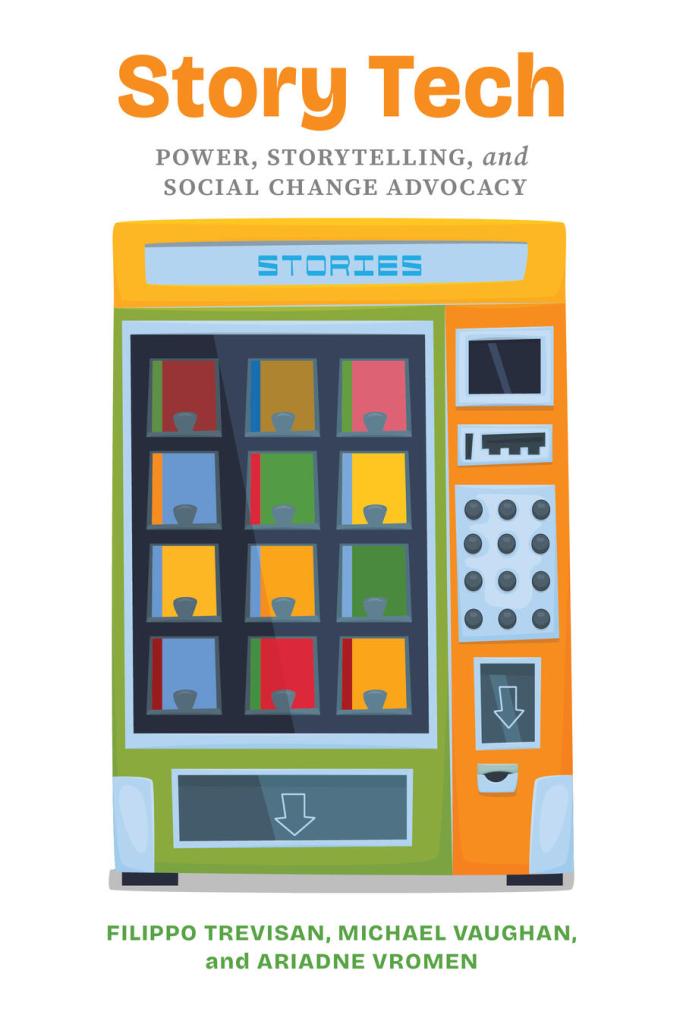
New Book! Story Tech: Power, Storytelling and Social Change Advocacy

My new book Story Tech: Power, Storytelling, and Social Change Advocacy, co-authored with Michael Vaughan and Ariadne Vromen, was released in February 2025. To get 30% off, you can use code “UMS25” on the University of Michigan Press website, or check out the Open Access e-book version!

Book synopsis: Personal stories have the power to stir the heart, compel us to act, and spark social change. While advocacy organizations have long used storytelling in campaigns, the role technology plays has increased. Today, invitations to “share your story” are widespread on advocacy organizations and political campaigns’ websites, calls to action, and social media pages. But what happens after one clicks “share”? And how does this affect which voices we hear—and which we don’t—in public discourse?
 
Story Tech explores the increasingly influential impact of technologies—such as databases, algorithms, and digital story banks—that are usually invisible to the public. It shows that hidden “story tech” enables political organizations to treat stories as data that can be queried for storylines and used to intervene in news and information cycles in real time. In particular, the authors review successful story-centered campaigns that helped change dominant narratives on disability rights, marriage equality, and essential workers’ rights in the United States and Australia. They compare the use of storytelling advocacy across different types of organizations including volunteer grassroots groups, large national advocacy coalitions, and trade unions, and examine how trends differ for storytellers, organizers, and their technology partners. As political stories shift to being “on demand,” they reshape power relationships in key public debates in ways that produce moments of tension as well as positive narrative change. Story Tech examines the shift toward political story “on demand” and illustrates how storytelling success can—and should—be achieved in conjunction with personal dignity, privacy, and empowerment for storytellers and their communities, particularly marginalized ones.
Routledge Handbook of Political Campaigning, published November 2024

In politics, timing matters. So, I’m thrilled to announce the release of the Routledge Handbook of Political Campaigning this November, in time for the U.S. 2024 elections! This volume, which I edited together with a stellar team including Darren Lilleker, Dan Jackson, Anastasia Veneti (Bournemouth University, England), Bente Kalsnes (Kristiania University College, Norway), and Claudia Mellado (Pontificia Universidad Católica de Valparaíso, Chile), offers an in-depth review of key trends in political communication and campaigning from various angles, from campaign tactics to civil society interventions, through 34 chapters that focus on case studies and countries well beyond the ‘usual suspects’ (U.S., UK). You can read more about the book and freely access a preview that includes the introductory chapter here.

#Notplayinggames: Social media advocacy at the Paris Paralympics

Did you notice the Paralympics on TikTok this year? You weren’t the only one! I enjoyed writing a short piece on the International Paralympic Committee’s bold and effective (though somewhat controversial) social media strategy, which made a big splash, got people talking about disability, and created a permission structure for athletes to engage in media advocacy. You can read more about this in this fabulous (and free!) report on the Paris Olympics, Paralympics, Media, and the Politics of Sports with contributions from over 100 leading experts.

New Article on Instagram Influencers with Disabilities in Celebrity Studies

Manuela Farinosi (University of Udine, Italy) and I have a new article out in Celebrity Studies: “Disabled influencers on Instagram: exploring digital celebrity and marginalised identities” (part of a special issue on Social Media Influencers edited by Rebecca Feasey). Here below is the abstract and you can access the full-text article at this link (if you can’t access it through your library and need a free copy, please just reach out and I’ll be glad to share one with you).

This article illuminates the nexus of social media, celebrity, and marginalised identities by examining the phenomenon of disabled influencers. Since the late 2010s, disability representations in media, culture, and public discourse have increasingly moved away from stigmatising stereotypes. Disabled influencers have emerged as new voices in this landscape but, so far, exploration of their work has been limited. To address this gap, this study explores how 15 diverse fashion influencers with visible impairments address disability in their personal brands, whether they frame themselves as advocates for disability rights, and investigates their relationships with both followers and commercial brands. Through a content analysis of one year worth of Instagram posts (N = 1,429) and profile information, we outline the strategies these influencers use to make disability central to their online personas, explore their multi-layered relationship with brands, identify their distinct but somewhat limited voice in disability advocacy, and highlight their engagement strategies with digital publics. Drawing on disability and celebrity scholarship, this work provides insights on how the use of participatory platforms like Instagram intersects with the changing demands and expectations of celebrity, generating both opportunities and constraints for traditionally marginalised groups. 

Information Tech & Politics at #APSA2023

The 2023 American Political Science Association’s conference starts tomorrow (August 31) – I’m honored to chair the Information Technology and Politics (ITP) Section and pleased to share a one-page overview of all ITP events at the conference, for ease of navigation (thanks Lauren Bander at American University for making this possible!). Just download the PDF below!

YDAR Festival of Disability Advocacy in Dar Es Salaam, Tanzania

In April, I was delighted to visit Dar Es Salaam, Tanzania for the Festival of Disability Advocacy organized by the Youth Disability Advocacy and Research (YDAR) network. This event brought together over 50 young disabled advocates, disability rights professionals, and academics from all over East Africa, the UK, and the U.S. for four days of knowledge exchange and campaign co-creation.

The Festival kicked-off a year-long project that will continue with a program of online workshops and trainings, and the development of grassroots disability rights campaigns led by young disabled leaders in East Africa mentored – both in person and remotely – by professionals and academics in the areas of disability rights, public policy, and media and communication. I’m proud to collaborate with an amazing team of colleagues from Bournemouth University (England) and ADD International Africa for this project, which is funded by the UK’s Arts and Humanities Research Council.

Awards Call: APSA Information Technology & Politics

Did you come across some stellar research in Information Technology and Politics published in 2022, or did you write some yourself? Consider nominating your work or the work of others for one of the 2023 APSA Information Technology & Politics Section Awards. Awards up for grabs include:

  • Best Information Technology & Politics Book Award (for books first published in 2022)
  • Best Article in Information Technology & Politics (must have appeared in a journal issue in 2022)
  • Best ITP Conference Paper Award (for papers presented in the ITP section at APSA 2022)
  • Best Student Conference Paper (for papers presented in the ITP section at APSA 2022)
  • Best PhD Dissertation in Information Technology & Politics
  • Best Public-Facing Scholarship in Information Technology and Politics

The deadline for submissions is April 1, 2023.

More information, including award committee members and contact details can be found here.

Invited talk on ‘datafied’ storytelling at #ZeroCon23

Last month, I gave an invited a talk at the Zero Conference 2023, one of the world’s largest gatherings about disability inclusion held at the United Nation’s offices in Vienna, Austria.

In my presentation, I discussed the pros and cons of ‘datafied’ stories as innovative narrative evidence in policy-making for disability inclusion, drawing on work I’ve done with Michael Vaughan and Ariadne Vromen for our forthcoming book on this topic. You can watch my presentation here. You can also watch all the different sessions on the Zero Project YouTube Channel (all the videos include captions and International Sign Language interpretation).

It was a honor and a privilege to connect with so many leaders in government, business, activism, academia, and international organizations who work tirelessly to build a more inclusive world. I’m grateful to the Zero Project and Essl Foundation‘s teams for this invitation.

#APSA2022 Information Tech & Politics Program

This year I’m honored to chair the Information Technology & Politics (ITP) program at the 2022 American Political Science Association‘s conference. Here’s an overview of all ITP events at the conference — hover over the image below to download a PDF copy and access direct hyperlinks to complete panel descriptions and paper titles in the online program. See you in Montréal!

Exploring digital inclusivity in U.S. progressive politics – new article in New Media & Society

My latest article titled Beyond accessibility: Exploring digital inclusivity in U.S. progressive digital politics was published recently in the journal New Media & Society. This work, which is part of a journal special issue on Vulnerability and Digital Media, draws on the experience of digital organizers with disabilities in the 2020 U.S. election campaigns to sketch a new framework to understand and study inclusivity in online politics as a “process.” This breaks with the restrictive interpretation of inclusion as an “outcome” of digital political participation and is intended to open new avenues for elevating under-represented voices in political communication research and practice.

The 2020 U.S. election was a watershed moment for inclusivity in digital politics due to activist pressure, cultural change, and the pandemic. The article highlights key role of disabled advocates and digital organizers – both from inside campaign organizations and from outside through initiatives like #cripthevote – in making candidates and their organizations more responsive. With digital campaigning center stage during the pandemic, crisis again proved to be an innovation catalyst in digital politics. Now, the sustainability of digital inclusivity depends on whether cultural change that views disabled people as full citizens and a key group to mobilize takes root in political organizations for the long term.

Here below is a copy of the abstract, you can find the full paper here (please get in touch directly if you’d like a pre-print version):

This article explores inclusivity in the context of digital politics. As online campaigns and digital participation become increasingly central to democratic politics, it is essential to better understand the implications of this shift for marginalized and politically vulnerable people. Focusing on people with disabilities, this study applies a grounded theory approach to investigate what factors shape inclusivity in digital politics and begins to theorize this under-researched concept. Through interviews with self-advocates and election professionals with disabilities involved in innovative digital mobilization efforts for progressive US political organizations and campaigns, as well as a review of related strategies, this article illuminates digital inclusivity as a “process” connected to, but also distinct from the “outcomes” of social and political inclusion and exclusion. Key incentives and obstacles are identified, and emerging principles of digital inclusivity that are simultaneously community-rooted and sensitive to the context of contemporary US politics are discussed.