AU IDPP Seminar: Storytelling and Digital Disability Advocacy

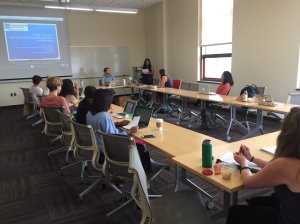
The Institute on Disability and Public Policy (IDPP) has launched its second seminar series on Disability, Development and Global Governance. Following an introductory session from IDPP’s director Dr. Derrick Cogburn, I was pleased to facilitate the second session in this fall’s series on Sept. 20th on the topic of personal stories in digital disability rights advocacy. You can find a brief summary of the event by clicking hereidpp-seminar_room

IDPP seminars will continue every Tuesday between 12-1:30pm in the School of International Service’s building, room 300, until December 6th. Anyone can attend. To check out the amazing line up of speakers from AU and the broader Washington, DC policy community, click here.
New Book: Disability Rights Advocacy Online – Out now!

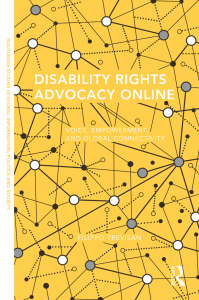
I’m excited to announce that my book “Disability Rights Advocacy Online: Voice, Empowerment and Global Connectivity” was released in October 2016. Both hard back and e-book versions are available from the Routledge website, as well as on Amazon and other online vendors (where it’s cheaper!).

Book Cover_2

Book cover: Disability Rights Advocacy Online

This book charts the recent digitalization of disability rights advocacy in the U.K. and the U.S., and discusses the implications of this transformation for disabled citizens and other traditionally under-represented groups. In just a few short years, disability rights groups have gone from using the Internet much less than other advocacy organizations to pioneering new uses of social media to foster a deep sense of agency and unify a very diverse community. To read a full book synopsis, click here.

APSA 2016 Presentation – Sept. 1st

I will present some of my most recent work on crowd-sourced story-centered counter-narratives as an advocacy tactic at this year’s American Political Science Association’s (APSA) Annual Meeting in Philadelphia, PA on September 1st. In this presentation, I will discuss the mechanisms that regulate story-centered counter-narratives and how these can be an important opportunity for the empowerment of politically inexperienced citizens. Click here to access the full conference program.

9th Conference of State Parties to the CRPD

This week I will attend the 9th Conference of State Parties to the Convention on the Rights of Persons with Disabilities (CRPD) at the U.N. headquarters in New York City as part of the delegation from American University’s Institute on Disability and Public Policy (IDPP), of which I recently became Deputy Director. This year marks a particularly important occasion as it is the 10th anniversary of the CRPD. In collaboration with other partners, IDPP has prepared two side events to this conference. These include:

  • Disability and Digital Societies side event: Wednesday, June 15th, 8-9:30am, UN conference room 11 – click here to attend this side event remotely;
  • Accessible Global Governance side event: Thursday, June 16th, 6:15-8pm, UN conference room 11 – click here to attend this side event remotely.

More information about each event is available here.

Presenting at ICA 2016 Preconference

I look forward to presenting some new work on promotional tactics in disability rights advocacy at the 2016 ICA Preconference “Powers of Promotion.” The preconference, which is sponsored by ICA’s Political Communication, Popular Communication, and Public Relations sections, will be held at the Embassy of Finland in Tokyo, Japan on June 8th. You can access a copy of the program here and follow the conference on Twitter at #powersofpromotion.

New Journal Article: Disability & Society

Disability & Society just published a new piece by myself and Charlotte Pearson (School of Social and Political Sciences/Institute of Health and Wellbeing, University of Glasgow) entitled “Disability Activism in the New Media Ecology: Campaigning Strategies in the Digital Era“. This work, which can be downloaded online ahead of print, explores the ways in which different disability activist groups in the UK are engaging with changing media landscapes in which both “new” and “old” forms of media interact to form public opinion and influence political decision-making. The paper focuses in particular on the case of the anti-welfare reform protests at the 2012 London Paralympic Games, in which self-advocates from Disabled People Against Cuts used both online and more traditional offline tactics to foster positive coverage of protest by traditional news media organisations.

New Book Chapter – Disability Protest at the 2012 Paralympics

Routledge just released a great volume on media representations of disability in the run up to, during and after the 2012 London Parlyampic Games. This book was edited by Dan Jackson, Caroline Hodges, MIke Molesworth and Richard Scullion at Bournemouth University and is entitled “Reframing Disability? Media, (Dis)empowerment and Voice in the 2012 Paralympics.”

I contributed one chapter to this book, which focuses on media representations of disability rights protesters during the London Games. The full citation is: “Contentious Disability Politics on the World Stage: Protest at the 2012 London Paralympics,” pp. 145-171. For more information about the book on Routledge’s website, click here.

Book Contract with Routledge: Disability Rights Advocacy and New Media in Britain and America

I am thrilled to say that I have signed a contract to publish my first book in the “Routledge Studies in Global Information, Politics, and Society” series edited by Ken Rogerson (Duke University) and Laura Roselle (Elon University). The book is entitled “Disability Rights Advocacy and New Media in Britain and America” and builds on my doctoral research. This work, which will be released in 2016, explores whether the Internet can re-configure political participation and policy-making to be more inclusive experiences for users with disabilities, enhancing their stakes in democratic citizenship.

New Journal Article: Scottish Disability Organisations & the Internet

Hot off the press: my latest article on the use of online media among Scottish disability advocacy organizations in Disability Studies Quarterly, Vol. 34 n. 3. Although online organising and campaigning have changed quickly in very recent years, this research, which was carried out between 2009 and 2010, asks fundamental questions about why advocacy group choose to adopt participatory technologies and how they try to manage them. In particular, I discuss the relationship between technological preferences and organisational ethos, structure and mission, which delayed the involvement of several prominent disability advocacy groups in Web 2.0 platforms in Scotland. To read the full text, click here (open access).

Paper accepted for ECREA 2014 conference

I will be presenting a paper at the 2014 European Communication Conference (ECREA) in Lisbon in November. My work will discuss ‘Digital Narratives, News Media Coverage and the Limits of Online Dissent’ using the experience of online disability rights activism in the UK as an emblematic case study. A lot has been said in recent years about the innovative tactics, structure and leadership styles of online activist groups. Yet, the relationship between campaigning strategies and concrete policy outcomes remains largely unexplored: why do many digital campaigns ultimately fail to influence public decision-making in democratic countries? My work will address this question by focusing on the clash between competing policy narratives in online activist narratives and established news media outlets.