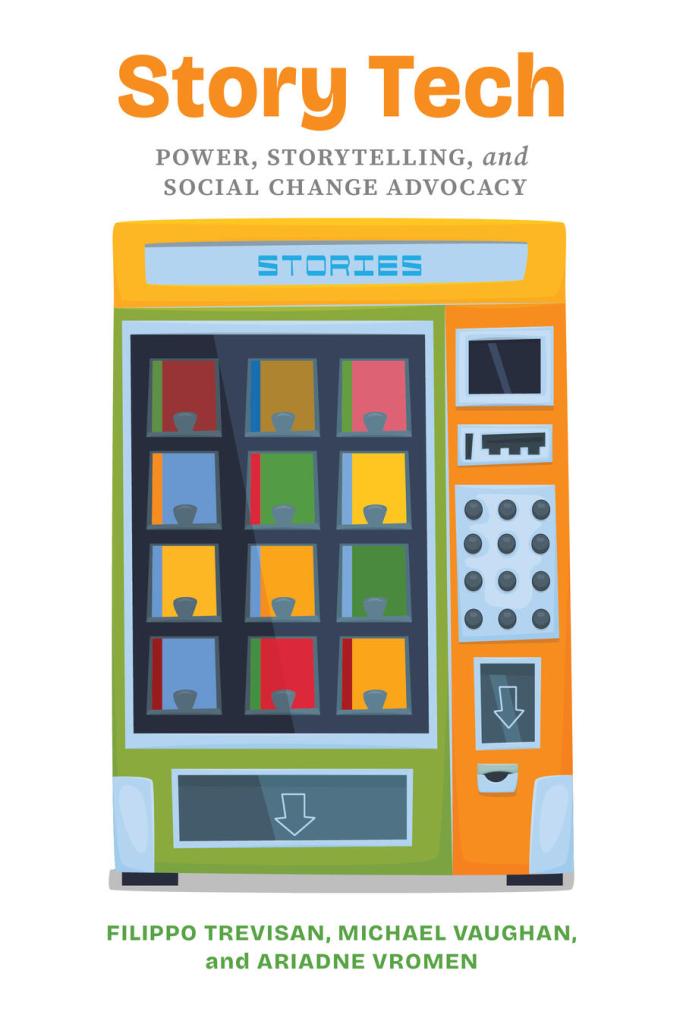
New Book! Story Tech: Power, Storytelling and Social Change Advocacy

My new book Story Tech: Power, Storytelling, and Social Change Advocacy, co-authored with Michael Vaughan and Ariadne Vromen, was released in February 2025. To get 30% off, you can use code “UMS25” on the University of Michigan Press website, or check out the Open Access e-book version!

Book synopsis: Personal stories have the power to stir the heart, compel us to act, and spark social change. While advocacy organizations have long used storytelling in campaigns, the role technology plays has increased. Today, invitations to “share your story” are widespread on advocacy organizations and political campaigns’ websites, calls to action, and social media pages. But what happens after one clicks “share”? And how does this affect which voices we hear—and which we don’t—in public discourse?
 
Story Tech explores the increasingly influential impact of technologies—such as databases, algorithms, and digital story banks—that are usually invisible to the public. It shows that hidden “story tech” enables political organizations to treat stories as data that can be queried for storylines and used to intervene in news and information cycles in real time. In particular, the authors review successful story-centered campaigns that helped change dominant narratives on disability rights, marriage equality, and essential workers’ rights in the United States and Australia. They compare the use of storytelling advocacy across different types of organizations including volunteer grassroots groups, large national advocacy coalitions, and trade unions, and examine how trends differ for storytellers, organizers, and their technology partners. As political stories shift to being “on demand,” they reshape power relationships in key public debates in ways that produce moments of tension as well as positive narrative change. Story Tech examines the shift toward political story “on demand” and illustrates how storytelling success can—and should—be achieved in conjunction with personal dignity, privacy, and empowerment for storytellers and their communities, particularly marginalized ones.
Advocacy and Personal Stories in Australia and the U.S. – Seminar at Melbourne University

I’m currently in Australia on a fieldwork trip for a new project and will present some preliminary insights at the University of Melbourne on Wednesday February 13 together with my colleague and collaborator Ariadne Vromen of the University of Sydney. This new work explores recent changes in how advocacy organizations approach storytelling and reviews the role of digital technology in the ‘datafication’ of storytelling techniques. The seminar will take place between 1:00-2:00pm in the Arts West North Wing building, room 253. We’re grateful to the Media and Communication Program for giving us this opportunity to discuss some of this new work.

Connective Action Mechanisms in a Time of Political Turmoil: Virtual Disability Protest at Donald Trump’s Inauguration – New article


AusJPS coverMy latest article is just out in the Australian Journal of Political Science. “Connective Action Mechanisms in a Time of Political Turmoil: Virtual Disability Protest at Donald Trump’s Inauguration” examines the forces that underpin the rapid formation of online counter-publics in the wake of disruptive political events such as Donald Trump’s election. Both the advantages and disadvantages of connective action as a response to this type of political upheaval among traditionally marginalized populations are discussed through a case study of virtual disability protest at Donald Trump’s inauguration (the “Disability March“). This article is part of a forthcoming special issue edited by Ariadne Vromen (University of Sydney) and Andrea Carson (University of Melbourne) for the Australian Political Science Association’s POP Politics Aus Group. Please contact me if you need a link to a free copy of this article. Here is the abstract:

This paper explores the connective action mechanisms that underpin the rapid formation of online counter-publics in the wake of disruptive political events through a case study of crowd-sourced disability protest launched in response to Donald Trump’s election as U.S. President. Coverage of this protest in U.S. news media is reviewed also as a first step towards assessing the ability of this initiative to influence public discourse. Findings suggest that controversial election results can spur mobilisation, but by themselves do not appear to be sufficient for connective action to really flourish and succeed. Personal action frames that typically are central to connective action struggled to emerge in crowd-sourced contributions that focused on Trump and his politics. The reasons behind these outcomes and their implications for the potential effectiveness of crowd-sourced protest are discussed.

On “Disability and Digital Citizenship” Panel at ANZCA 2017

Third and final talk of this Australian trip – I am excited to join a pioneering panel on “Disability and Digital Citizenship” at the 2017 Australia-New Zealand Communication Association’s conference later today at the University of Sydney. The panel will start at 2:30pm in New Law 106.

This panel brings together a number of scholars doing work on disability, technology and different aspects of participation and inclusion, from economics, to media, to politics. I will present some new research on how Americans with disabilities used the Internet to participate in the 2016 U.S. presidential election.

Thanks to my colleagues Prof. Gerard Goggin (of the conference organizing team) and Prof. Haiqing Yu for inviting me to this panel.

Invited Seminar at the University of Newcastle, NSW

Second Australian talk – I will discuss my book “Disability Rights Advocacy Online” during an invited seminar at the University of Newcastle. The event on Monday, July 3rd will start at noon in Room GP2.01 at the Callaghan Campus. Free registration is available here and the seminar will also be streamed live online. Anyone can join remotely by clicking here. The official Twitter hashtag for the event is #DisabilityRightsUON

I look forward to connecting with a wonderful group of scholars that does some great work on multiple aspects of disability and discuss how the book can help us to understand some of the latest developments in disability rights advocacy, including grassroots mobilization in the wake of Donald Trump’s election as U.S. President.

Special thanks go to my colleague Prof. Bronwyn Hemsley for being the driving force behind this event.

Workshop at the University of Melbourne: Political Action in the Digital Age

I am delighted to join colleagues from across Australia and the U.S. at a workshop on Political Action in the Digital Age organized by the Pop Politics Aus group at the University of Melbourne on June 29-30. My presentation is titled “When in Shock, Turn to the Internet,” and discusses the virtual response from the American disability community to the election of Donald Trump as the 45th U.S. President.

This is the first of three events at which I will speak during a brief visit to Australia over the next few days to connect with leading researchers in the fields of disability and technology, as well as online politics at the Universities of Sydney and Newcastle. I will publish more details about the other events in the next few days.